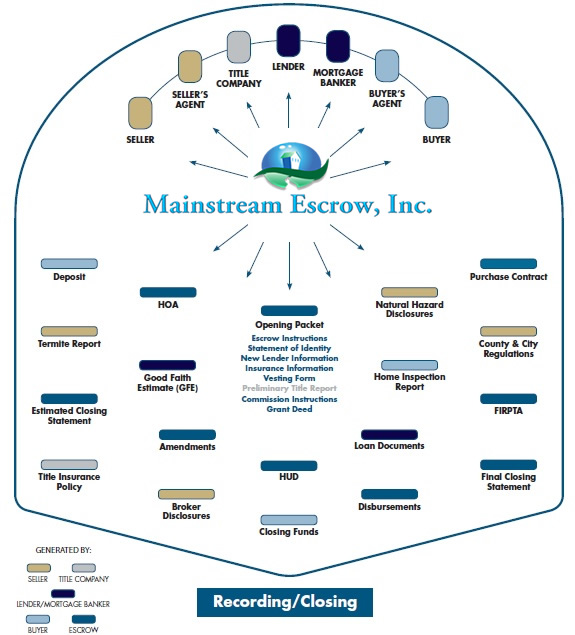
CLICK PHOTO TO ENLARGE
Escrow in California is a complex process. Escrows are used only in California and thus the very word “escrow” seems foreign to people coming from other parts of the country. Escrow is defined in the dictionary as: “Money, property, a deed or a bond put into the custody of a third party for delivery to a grantee (buyer) only after the fulfillment of the conditions specified;” in plain English, “Escrow” is a referee between buyers, sellers, lenders, title companies, agents, etc. The “Escrow” is the holder of the documentation and funds, carrying out the instructions of a previously executed contract, generally the Purchase Agreement and Receipt for Deposit.
Buyers, sellers, real estate licensees and lenders often misunderstand escrow. Individuals speak of placing one’s property “in escrow,” as if the escrow is a “place.” It is not! Escrow is a holding station where parties to a transaction instruct a neutral third party, the Escrow Officer, to carry out the terms and conditions of the Purchase Agreement and any Counter Offers. Escrow officers do not practice law.
Many buyers and sellers erroneously believe that escrow is responsible for the successful closing of the sale. It is not! Escrow is an administrative “clearing house” which takes instructions from buyers, sellers, brokers, lenders, title companies, termite companies, governmental agencies and others. Who actually coordinates these various entities, instructs the escrow officer and neutralizes the emotional turmoil that potentially endangers a successful escrow? Either the buyers or sellers, representing themselves, or the professional real estate agent or broker representing their clients, are responsible for assuring a smooth transaction and escrow closing.